
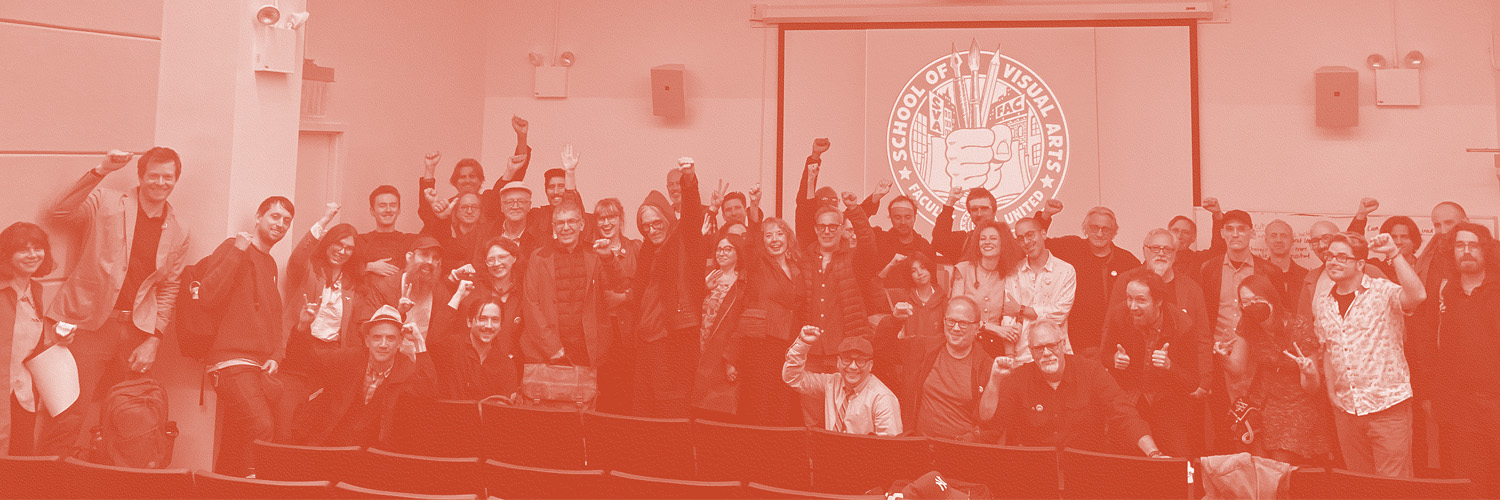
As faculty, we are coming together as a union so we can bargain collectively with SVA. We are joining the thousands of academic workers at NYU, Columbia, and the New School (Parsons) who are seeking to secure a better future through collective bargaining, and we are part of a growing movement in private institutions like RISD, Pratt, Cooper Union, and California College of the Arts, where unionized faculty have negotiated meaningful improvements to salary, benefits, and working conditions.
Without collective bargaining, we have experienced stagnant salaries, increasing amounts of uncompensated work, vanishing benefits, and threats to job security and academic freedom. If our benefits and working conditions are secured in a collective bargaining agreement, SVA cannot change the terms of our employment without our consent. As employees across SVA, we have formed a union in order to improve our working conditions and to make the school a more equitable and accessible institution for teaching and learning.









About Us
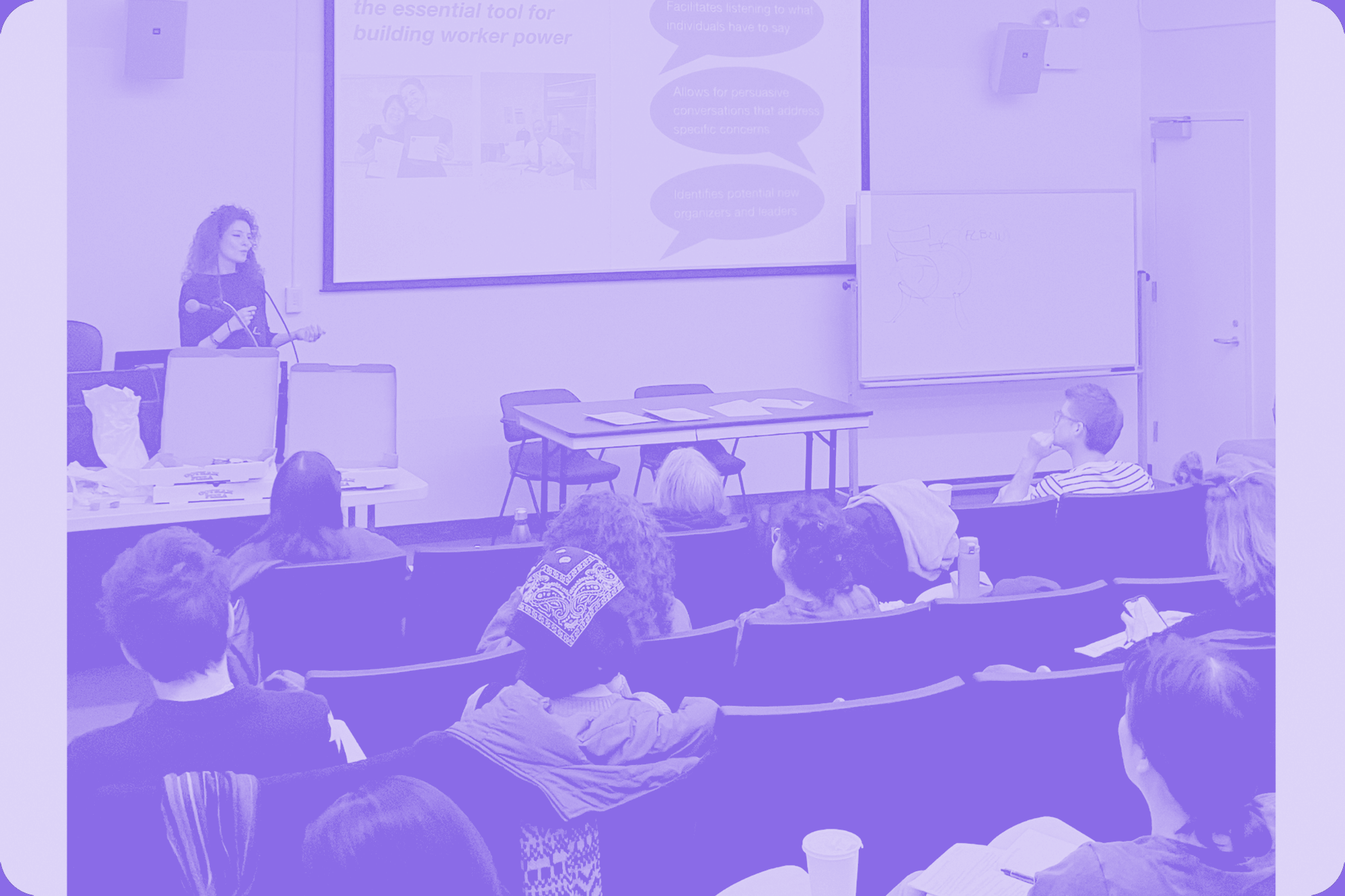
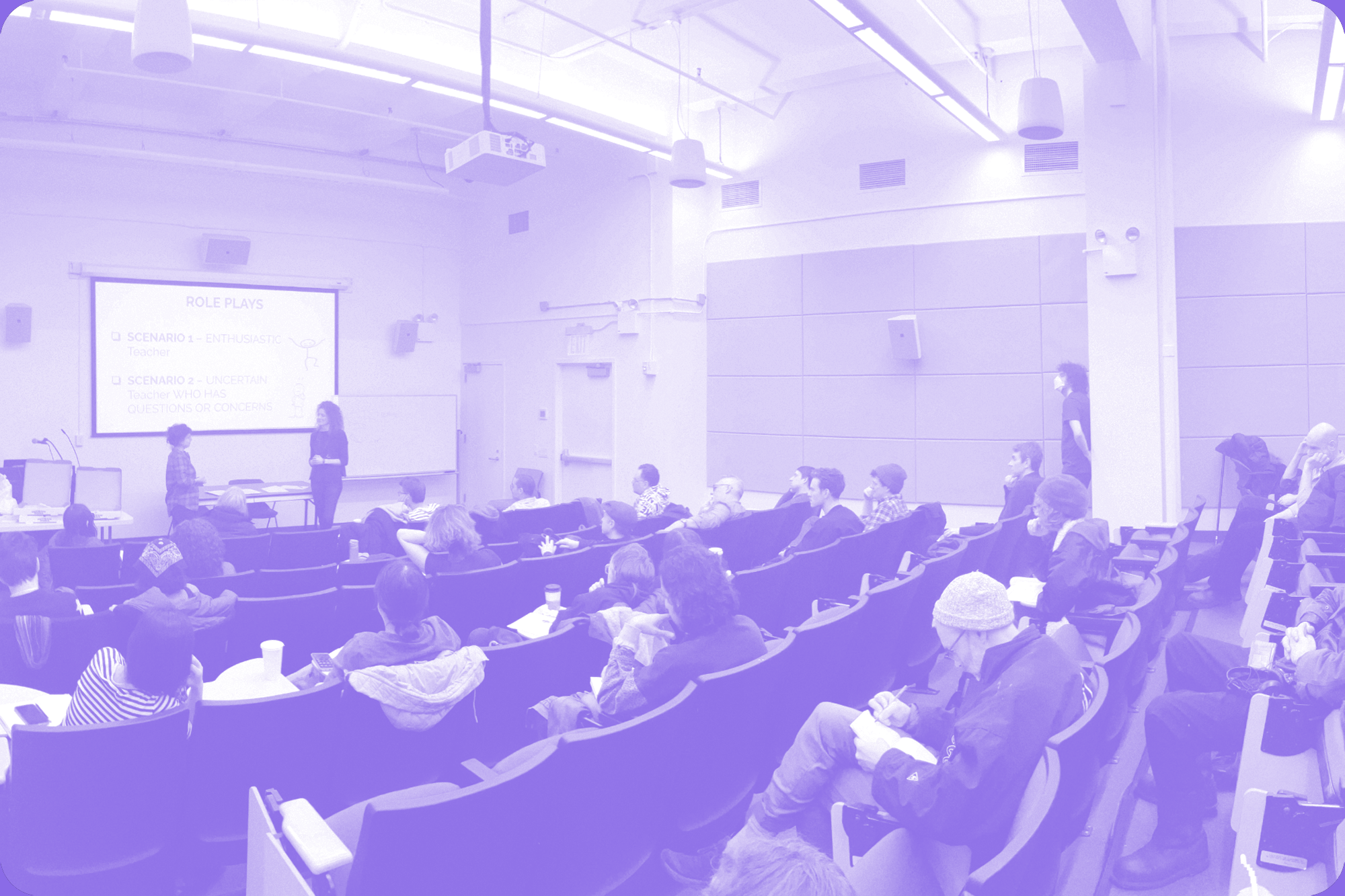
We are an organization by, for, and of SVA faculty who want to unionize to improve our teaching and employment experience here at SVA. Our teaching not only benefits SVA and New York City, but has lasting deep impacts on our students. We work in many different fields and have varied experiences, but our dedication to teaching unites us all.

LEE-SEAN HUANG
MFA Design for Social Innovation
I have personally benefited from the results of collective bargaining at peer institutions. I have also taught at The New School and NYU, and I have seen first-hand how our union-negotiated contracts there have resulted in significantly better pay and contractual terms, including pay for prep work done before the semester starts. While organizing and taking collective action with my coworkers, I have also found community, something particularly important for adjuncts who are often busy juggling multiple teaching gigs and other professional obligations. This is why I support a faculty union at SVA.

JOAN HILTY
Comics
I love teaching professional practice at SVA; as a fulltime creative executive in entertainment, I'm passionate about preparing my students for successful careers in the arts. But it's hard to teach meaningful standards about what work is worth when I cannot even use my own school as an example. SVA lags far behind its competition by having no clear standards for pay, benefits, or job security. I want a faculty union because I believe in the importance of fair wages and working conditions, and I want to teach at a school that supports that as well.

JUSTIN ELM
Honors, Art History, VCS
I support forming a union at the School of Visual Arts because we need a unified voice to address the concerns and well-being of all faculty members. A union, via collective bargaining, provides a powerful platform for us to negotiate wages and benefits and provides job security and a sense of stability. Unionizing ensures that our hard work and dedication to the students are rewarded with fair and just compensation. It will assist in creating a more equitable distribution of resources and foster a workplace where every individual is valued and respected. By joining forces and working together, we can create a better, more equitable future for everyone associated with SVA.

JENSINE ECKWALL
Illustration
As an SVA graduate and instructor, SVA means so much to me. It is the place I found my community, and my goal is to continue to help build community there. I am proud to support the advocacy, voice, and stability that collective bargaining can bring to all our valued faculty.

PETER LARSON SCHMIDT
Animation
I agree with the SVA administration that a faculty of working professionals is necessary to prepare students for a career in the arts. But balancing the responsibilities of teaching with a professional art practice is an extremely demanding requirement to ask of the SVA faculty. As the art world changes around us, it is becoming increasingly difficult to succeed in both without the robust, representational support of a union. For the sake of our students and SVA itself, I believe that we must unionize.

JENNIFER WEN MA
MFA Fine Arts
I support forming a union because I want to build a strong community with my fellow faculty, advocate for our professional needs, and ultimately create a more conducive ecosystem for learning. So much of teaching is about showing up for other people. Unionizing is about showing up for ourselves and fellow faculty. Modeling community building and advocacy is an important lesson for our students as well.

EMILY BLAKE
Humanities & Sciences
As a member of Actors Equity Association, the actor’s union, I have first hand knowledge of the importance of having a union and the power of organizing. Only by uniting with our colleagues can we effectively negotiate with employers for the things all workers need – the right to regular raises and open discussion of working conditions. Most of all, we need to inspire not only faculty and staff, but also the students we instruct, with a model of self-determination and collective activity in the public and political spheres.

LILY PADULA
Illustration
I'm proud to support a union for the benefit of all SVA faculty and staff. By engaging in collective bargaining, we can follow in the footsteps of our peers at institutions across NYC and make SVA a better place to work and learn.

MEREDITH NOLAN
Animation
SVA prides itself on the quality of education it provides by employing working professionals and is important to the representation of the school. However, the time spent on developing curriculum, communicating with students, and grading extends far beyond the time I am being paid for, which is not right. With a union, I believe we’ll be able to negotiate a contract in which we can continue to provide a high quality education while being fairly compensated for our time and experience.

KAITLIN POMERANTZ
MFA Fine Arts
A union at SVA will ensure we have a guaranteed voice to help faculty advocate for more reasonable pay. Pay equity is a race and gender issue-- across universities, it is typically POC, women + NB faculty who hold precarious contingent positions, and earn the least. Faculty teaching conditions are student learning conditions!

EDWIN RIVERA-ARIAS
Humanities & Sciences
My abuelito was a maintenance worker in a housing complex in Queens for many years. He belonged to a union. Whenever he felt he was being mistreated, he'd exclaim, "I strike!" My father, as a factory man, was a member of numerous unions. And I eventually followed in their footsteps, becoming a proud member of the United Steel Workers in my former capacity as a laborer and a dockman for International Matex Tank Terminals. My personal experiences have taught me that we can protect ourselves by forming a union. What we do now can improve the lives of hundreds of teachers, and determine a brighter future for those who are next in line. Union is solidarity; union is power for the worker; union is a social responsibility.

JOAN BROOKER-MARKS
BFA Film
Having been a member of various unions over the past four decades, I know firsthand how important it is to have a voice at the table. A union will ensure clear lines of communication with the administration, provide equitable pay and affordable health care, and more importantly — protect us, the workers, who make this institution function and thrive.

HANS TAMMEN
MFA Computer Arts
I first became part of a union at the age of 18 because it is good to speak with a unified voice. I witnessed the benefits of being a union member firsthand at my college in Germany, where I was one of our student representatives. With lots of things on the table it would not have made sense to talk about each of these issues only on an individual basis. Being able to bargain collectively gives all of us more power to secure meaningful protections and improvements together.

SETH TOBOCMAN
Comics
Faculty are not only charged with conveying our technical skills to a room full of students, but with counseling people at a very vulnerable and emotional moment in their lives. If we do our job right, we will provide young artists with the opportunity to express things they have never expressed and to tell certain stories for the first time. No one spends more time with these students than their instructors and it is important that instructors have a role in shaping curriculum. I am for a union at SVA because I hope it will create more of a level playing field between the instructors and the administration so we will be in a better position to represent the interests of our students.

TOMMY MARTINEZ
BFA Design
I support forming a union at SVA so that faculty members can negotiate for sufficient resources, stability and care we need to continue to offer students the best.

NELSON ISAVA
BFA Film
I’m an SVA alumni. I love this school and all it taught me. I support forming a union so we can have a say in determining what protections we have as adjunct faculty when it comes to health care, job security and class development or class prep pay. I believe that if we as a faculty body feel protected and fairly compensated, then our students will get a far better experience while attending SVA. Forming a union is our best chance at accomplishing that.

KRISTIN L. WOLFE
Humanities & Sciences
We answered the call to teach out of a passion for our craft---which is why we chose SVA and why SVA chose us--but we also teach in order to pass the torch of passion and knowledge to our students.Coming together to form a union will not only raise the bandwidth of our collective voices, but add to the rewards we receive by being in a classroom everyday. Being authentically supported, and respected by our administration for what we bring to the table, is worth standing up for; and I think our students would be honored by the stand we are willing to take on their behalf and ours as a united faculty.

ALEX KROKUS
Animation
Experienced arts educators do not come from their respective professional arts industry. Experienced arts educators come from years of honing their craft of arts education. Those years are best ensured through job security and job security is ensured with the protection of a union. I support a union at SVA because I believe all students, faculty and administrators deserve the prestige of a staff of elite arts educators with years of uninterrupted experience.

CHARLIE SCHNEIDER
Humanities & Sciences
I love teaching writing at SVA, and I want to keep doing it in a way I can count on. I was excited when SVA told me they offered healthcare benefits, until I actually looked at the numbers. There was no way I could afford it. When I became involved in the effort to form a union, I learned my experience was not at all exceptional. I want to form a union at SVA that will fight for all of us, in solidarity and friendship.

JASON LITTLE
BFA Comics
I feel strong loyalty to SVA, as a longstanding teacher who has never taught anywhere else. That's why I want to work hard to bring democratic representation and collective bargaining to our school, as it is the next logical step in our development as a strong and healthy institution. We need to do this not just for ourselves, but to set an example for other workplaces—and governments—worldwide.

JOSH HOWELL
BFA Animation
I support forming a union because collective bargaining will allow us to advocate for ourselves and create a more stable and secure teaching environment. When we improve teaching conditions, we create a space for both students and teachers to thrive in.

Devin Garth Thornburg
MA/MAT Art Education
Over the past three decades, I have watched higher education institutions become more corporate and less focused on the creation of a community. Having taught in several places, I see how there is a tendency now to teach our classes and go home. There is no community-building or the cultural capital that I saw in years past and I want to see a union in place to support our rights but to also allow for a creation of a community of knowledge sharing that is at the heart of life in higher education.

ROXIE VIZCARRA
BFA Illustration
I support forming a union at SVA because I myself am a product of a New York City art school education. I recognize now that it wasn’t the facilities, the curriculum, or even the city itself that most shaped who I am as an artist today, but that it was the teachers: the professional artists volunteering their valuable time, skills, life experience, often without sufficient support from their administration. What is an art education without the teachers to shape the students? I believe it is the duty of educational institutions to recognize the value of their faculty. That faculty should earn a liveable wage that supports their art practice, and future generations of artists should know their institutions respect and value them.

MERLIN URAL RIVERA
Humanities & Sciences
I end every semester by showing my students a clip in which writer Harlan Ellison advises writers to demand fair pay for their work and not let anyone take advantage of their talent. Unfortunately, as a writer and an underpaid adjunct, this is my reality. SVA's administration relies on our good will and passion as teachers and has forgotten that what we do is highly-specialized work that warrants compensation in line with the skill set. There is dignity in getting paid fairly that we must protect, and we should set an example for our students who are likely to enter industries with similar exploitative practices. Without collective action, we are alone in our fight.

MIKE CAVALLARO
BFA Comics
The cartoonists I know, especially the educators, love what we do and are always ready to share. This ought to be rewarded, but instead it makes us easy to take advantage of, so never mind rewards. What’s needed is a degree of support and investment that equals the level of knowledge and expertise we routinely deliver to our students. I’m joining with my colleagues to give voice to these needs. SVA is not the buildings, rooms, workstations, etc., that facilitate our lessons. It’s those of us who work every day to affirm the school’s reputation. The institution can’t move forward into the future with success and stability if we lack these things ourselves.

RAY ALMA
Animation
I've been teaching at SVA for a number of years now. It's also my alma mater so I'm very attached to it. And while it is a good place to teach, it can be better with a faculty union. I'm hoping we can get compensation for class prep time done at home, and also hoping that by forming our union, we can negotiate to curb the intrusion of unethical Artificial Intelligence programs being used at the school.

CHRISSY FELLMETH
Animation
I'm for forming our faculty union because we deserve a say in how we are treated at SVA. Teaching at SVA has been one of my life's most outstanding achievements. My students look to me for advice as they begin their careers, and unionism has allowed artists to support families, buy homes, and live the American dream. By forming a union at SVA, we are setting an incredible example for future generations of workers in the arts.

GUSTAVO MURILLO FERNÁNDEZ-VALDÉS
BFA Fine Arts
By forming a union so that we, as faculty, can bargain collectively, I believe that my colleagues and I can get a fair deal in terms of salary, benefits and job security.

PILAR GARCIA-FERNANDEZSESMA
Animation
As a union, we could negotiate for compensation for all of our work, like paid office hours to cover the out-of-class work that my students really need from me on a weekly basis. My country, Spain, has a robust history of unions, which were instrumental in the development of democracy in the country. I think collective action is a necessary step that helps all parties involved improve the workplace, the student experience, and our relationship to the community. I love SVA and I think being able to bargain for extra resources and job security can help us dedicate more time to our students without worrying as much about our expenses, and help keep newer adjuncts in the community long term.

BILLY ALTMAN
Humanities & Sciences
Unionization has traditionally been the best way possible for workers in any field to improve compensation for their hard work, better their conditions in the workplace, and make their voices heard in terms of how their organizations operate. At SVA, establishing a union will also move the school to better support its instructors, which will ultimately strengthen the institution as a whole. Unionization will not only help connect adjuncts from across the SVA spectrum in our shared endeavors, but will aid in bringing all of us, labor and management, together as true partners in guiding SVA’s future as a welcoming home for students and teachers alike.
Sign A Card
We are joining together for a better SVA. Collective bargaining means more rights and more power to shape our lives at SVA. Collectively we have more power to negotiate with SVA than we have as individuals.
We are joining thousands of UAW educators across the USA in efforts to achieve better working conditions, wages & benefits.
WITH A UNION
We elect a bargaining committee that gathers in-put from faculty across campus.
Our bargaining committee negotiates on equal footing toward a fair agreement with SVA.
We decide democratically, through a vote, whether to approve any agreement as our contract.
That contract secures our terms and conditions of employment and is binding and enforceable, usually through appeal to a neutral arbitrator.
WITHOUT A UNION
SVA unilaterally determines our working conditions & can change them at any time without our consent.
FAQ
Under collective bargaining in the UAW, faculty fill out bargaining surveys to articulate priorities for a contract. We also elect representatives, fellow faculty, to a bargaining committee. Guided by the feedback in the bargaining surveys, the elected committee develops bargaining goals that we vote to approve, before sitting down with the administration and negotiating contract proposals. Once a tentative agreement is reached, faculty must vote to accept or reject the contract before it goes into effect.
Thousands of faculty in New York City at Universities such as NYU, New School (Parsons), and Barnard have won strong union contracts and are represented by UAW.
We reached out to UAW to help us successfully form a union at SVA because it has expertise in bargaining under the National Labor Relations Act (the law which makes it possible to collectively bargain at private universities) and their track record of success. Additionally, adjunct faculty at NYU and part-time faculty at the New School (Parsons) are a part of the UAW and recently negotiated strong, precedent-setting contracts.
We hope that by working together with our colleagues at NYU and the New School, we can have a greater impact both at institutions of higher education and in society more generally.
No one can be required to become a member of the Union after we have a contract. In most contracts, since everyone in the bargaining unit must receive all of the benefits of the contract, non-members are generally required to pay a comparable “fair share” fee, so the cost of representation is shared equally. The inclusion of a similar provision at SVA would be something we decide as part of our bargaining agenda, would be subject to negotiation with SVA’s administration, and contingent on ratification as part of our contract.
Many private sector academic worker unions have such a provision in the contract because it means we have more power and more resources available to enforce our rights under our contract, campaign for the best possible future contracts, and help other academic workers form their own unions. Under the UAW, there is also a one-time initiation fee, which ranges from $10 to $50 and is determined democratically in local union bylaws approved by members.
Thousands of academic workers have democratically decided to go on strike in the past few years to win their demands. In 2022, Part Time Faculty at the New School authorized and went on strike until reaching an agreement with administration that significantly increased compensation, established professional development funds, and more. After many months of bargaining, Graduate Student Workers, Postdocs, and Academic Researchers at the University of California also went on strike and won some of the best contracts in higher education.
Further, it is not uncommon for workers to decide that it is necessary to prepare for a possible strike in order to convince a school to reach a reasonable agreement during negotiations. In 2022, NYU adjunct faculty with ACT-UAW 7902 voted to authorize a strike, bringing the NYU administration back to the table and winning contract terms that set a new standard for part-time faculty compensation nationwide.
As an increasingly significant part of the UAW, academic workers have joined in the union’s longstanding commitment to social justice to prioritize issues of importance to workers at U.S. universities such as civil rights, immigration reform, access to affordable and quality education, federal funding of innovative basic science research, healthcare reform, the right to collective bargaining, and many other issues.
Contract Gains by
Other Academic Unions
• A right to reappointment and cancellation fee if a class is canceled last-minute.
• Healthcare coverage to faculty who teach just one course a year.
A $100k per year professional development fund that is administered by faculty, not administration.
• Academic Freedom: Right to freedom of expression and protection from unjust discipline and discharge.
• NYU adjunct faculty increased access to healthcare coverage, retirement benefits, professional development funds, commuter support, and more.
• Barnard contingent faculty won longer contracts and separation pay for longer-serving adjuncts who are not rehired.
• Barnard contingent faculty negotiated for and won a Scholarship Fund for their children’s college tuition.
Contact Us
We are an organization by, for, and of SVA faculty who want to unionize to improve our teaching and employment experience here at SVA. Our teaching not only benefits SVA and New York City, but has lasting deep impacts on our students. We work in many different fields and have varied experiences, but our dedication to teaching unites us all.
We are joining together for a better SVA. Collective bargaining means more rights and more power to shape our lives at SVA. Collectively we have more power to negotiate with SVA than we have as individuals.
We are joining thousands of UAW educators across the USA in efforts to achieve better working conditions, wages & benefits.